Skip to content

Dental Implants for Multiple Teeth in Thailand

Enjoy a firm bite again with several teeth back in place.

Chew on both sides again, with several teeth fixed in place rather than resting on your gums. You will not need an implant for every gap, one bridge can span more than one.

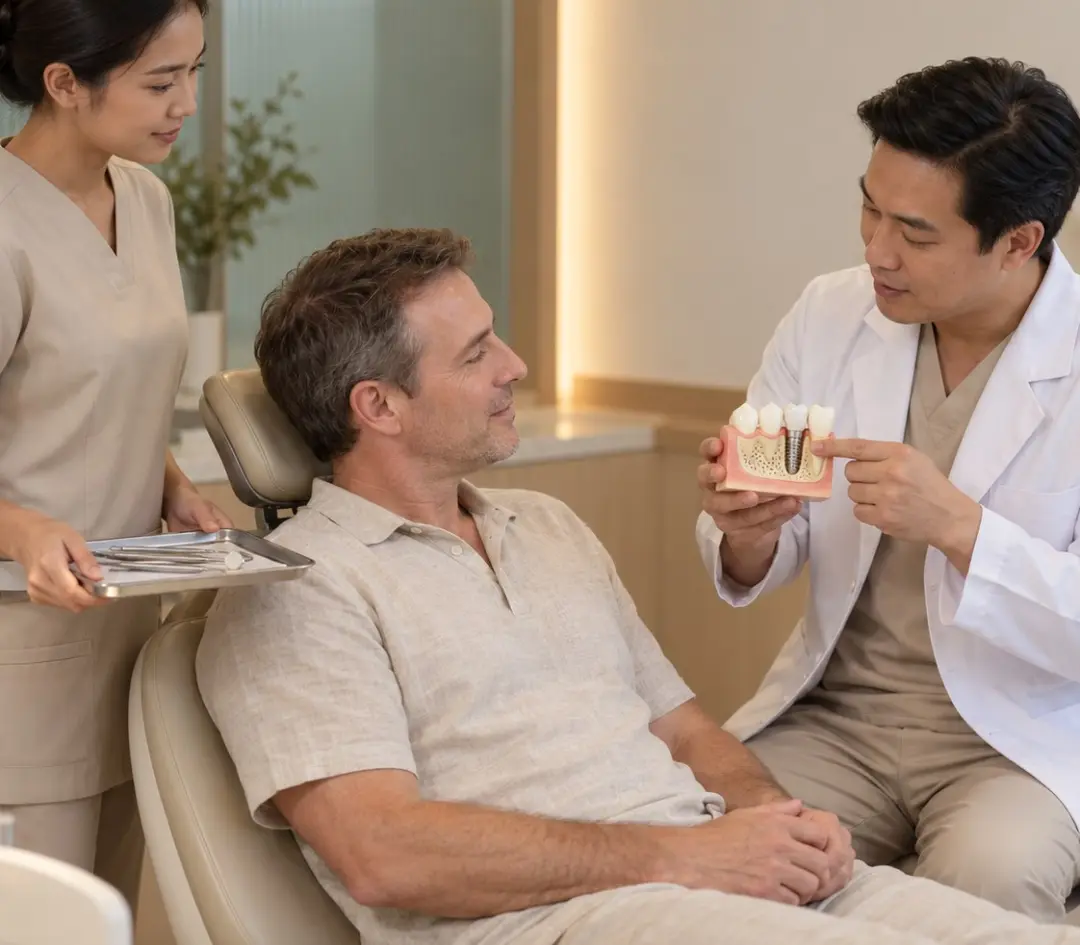
A dentist shows an implant model to a patient seated in a treatment room

What implants for multiple teeth are

Dental implants are small posts placed in your jawbone to replace missing tooth roots and support replacement teeth fixed in your mouth.

You can regain a firm bite for chewing your everyday food and fill the gaps in your smile with teeth shaped to look natural alongside your own.

You do not necessarily need an implant for every missing tooth: neighboring gaps can be restored with an implant-supported bridge, a connected row of replacement teeth held by implants.

For gaps in different parts of your mouth, your dentist may plan separate implants with individual crowns, the visible replacement teeth attached above the gums.

With good care, your implants can last 20 years or more. The crowns or bridge may need repair or replacement sooner.

You can receive internationally used implant systems in Thailand. Our partners offer systems such as Straumann and Nobel Biocare, with the choice confirmed by your dentist in your plan.

How much it costs

In Thailand you can save 40 to 60 percent compared with prices at home, while our partners provide care of a comparable standard.

Bridge prices are for a bridge of three teeth on two implants. Bone graft per implant site, sinus lift per one sinus, and the temporary tooth while the implant heals, for one denture, upper or lower.

About these prices

  • All prices are estimated, your doctor confirms your exact cost once they have examined you

  • Consultations, X-rays and scans are priced separately unless stated

  • Thai clinics add a small service or sterilization fee at each visit

What to expect

You usually need two trips to Thailand, with time between them for the implants to join firmly with your jawbone before your final teeth are fitted.

Your first trip

  1. Meet your dentist and agree on the plan. Your dentist examines your mouth and plans the number and position of your implants. In Thailand, cone beam CT, a 3D X-ray of your jaw, is available for assessing bone and nearby structures before implant surgery.

  2. Have your implants placed. Your dentist places the implants at the planned sites in your jaw, using local anesthetic to numb the area. Temporary teeth can cover visible gaps while you heal, with the design agreed before surgery.

  3. Return for a healing check. Your dentist checks the surgical sites and removes any stitches that need to come out.

Your second trip

  1. Check the implants and record your bite. Your dentist confirms that the implants are ready, then records your bite and takes impressions or intraoral scans, which are digital scans of your teeth, for the laboratory.

  2. Try in and fit your new teeth. Your dentist checks the shape, color and fit, then attaches the crowns or bridge to the implants.

  3. Return for a final fitting check. Your dentist checks your bite after you have used your new teeth and makes any adjustments before you leave Thailand.

With our partners, among Thailand's leading hospitals and dental clinics, your surgery and the fitting of your teeth are planned as one course of treatment.

Why Thailand for dental care

Thailand is a leading destination for dental care, not only for implants and cosmetic dentistry.

  • In-house or partner dental labs, for quicker turnaround and tighter control over quality

  • Most dentists speak fluent English

  • Consultations typically include 3D scanning or digital impressions

Who it suits

You may be suited for implants if you have several missing teeth and want a fixed replacement, subject to your dentist's assessment.

Your dentist checks:

  • Bone: your dentist assesses the bone at each gap and whether you need a bone graft, a treatment to build up bone.

  • Gums and teeth: gum disease and decay are checked, and problems that would affect implant treatment are treated before surgery, gum disease to a stable state.

  • General health: your dentist reviews conditions and medicines that could affect healing, as well as smoking, before deciding whether surgery can go ahead.

  • Bite: your dentist checks how biting forces will fall across the replacement teeth, including the effect of any clenching or grinding.

A removable partial denture, which replaces several missing teeth, is an alternative your dentist can discuss with you.

Before your appointment

Leave room in your itinerary for appointments and recovery, and settle the practical details before booking flights.

  • Time in Thailand: allow two to three weeks for your first stay. For your second stay, allow another two to three weeks.

  • Your health history: prepare a list of your health conditions, medicines, supplements and allergies for the clinic's review. We help you gather what the clinic needs for your assessment.

  • Your appointments: we book your appointments and send a reminder and a short brief before you attend. You can have implant consultations in English in Thailand, allowing you to discuss your plan directly with the treating dentist.

  • Your budget: allow for flights, accommodation and any preparatory dental work as well as the implants and replacement teeth. We can give you an estimate beforehand. Your dentist confirms the exact price after examining you.

  • Changes to the schedule: if teeth need removing or bone needs building up, you may need extra appointments and healing time. Your dentist confirms the sequence after assessment.

Choose changeable flights so you can adjust your dates to the confirmed plan.

After your treatment

Plan for healing after surgery and ongoing care once your new teeth are in place.

  • The first days: choose soft foods and avoid chewing over the implant sites until your dentist says you can. Follow the clinic's cleaning and medicine instructions.

  • Healing between trips: allow three to six months for the implants to join with the bone before the second trip. You can usually recover at home, with check-ups there as directed by your treating dentist.

  • Traveling home: complete the planned review before departure. After surgery, your dentist also confirms when it is safe for you to fly based on your healing.

  • Long-term care: brush twice daily, clean around your implants every day, clean beneath any bridge with the aids your dental team shows you, and attend regular dental and hygiene appointments.

  • Support: you can contact your clinic if anything worries you, or us if we arranged your care; we follow up after treatment and pass concerns to your treating dentist.

Keep your implant details with your dental paperwork for future appointments.

Your next step

Firm teeth for everyday food and a natural look for your smile: we help you plan the appointments for both.

Tell us which teeth you want to replace. Through our online concierge, we connect you with vetted partner hospitals and dental clinics and plan which dentists you see and when, at no extra cost to you.

Thank you!

We have received your request and will contact you shortly. If you don't see an automated email in your inbox in the next few minutes, please make sure to also check your "Spam" folder.

We look forward to helping you getting the best medical care in Thailand!
Form submission failed, please check the following error(s):

Questions